
 Quynh Pham
Inventory is where small and mid-sized retailers quietly lose money. Cash sits in items that do not sell, best sellers run out on a Friday afternoon, and ordering is done from memory by the one person who knows the shelves. Artificial intelligence is now marketed as the answer to all of this, and in the right conditions it genuinely helps. Across the retail businesses in the Gloria Capital portfolio, we have learned that the conditions matter more than the software. Here is how we approach it.
Start with data you would bet on
Every forecasting model, from a spreadsheet moving average to a machine-learning system, is only as good as the sales and stock data it learns from. In many independent stores that data is unreliable: items are rung up under the wrong code, receiving is recorded days late, counts are adjusted without explanation, and the same product exists under three descriptions.
Before any AI tool is switched on, we fix the basics. One product record per item, receiving posted the day goods arrive, cycle counts on a schedule, and a short list of reasons for every adjustment. This is unglamorous work, but it is the difference between a system that improves ordering and one that automates existing mistakes at scale.
Pick the problem, then the tool
AI in inventory management covers several distinct jobs. Demand forecasting predicts what will sell by item, store, and week, including seasonality and events. Replenishment turns those forecasts into order quantities and timing. Assortment analysis identifies items that should be delisted or added. Anomaly detection flags shrink, mis-scans, and receiving errors. Each of these has a different payoff, and a store rarely needs all of them at once.
For a wine and spirits retailer, the highest value is usually in replenishment for the fast-moving core and in identifying slow stock before it ages out of season. For a beauty studio, it is in consumables and retail products tied to appointment volume. For a distribution business, it is in forecasting by customer and channel. Choosing the single problem with the largest cash impact keeps the project small enough to finish.
Keep a human in the loop, on purpose
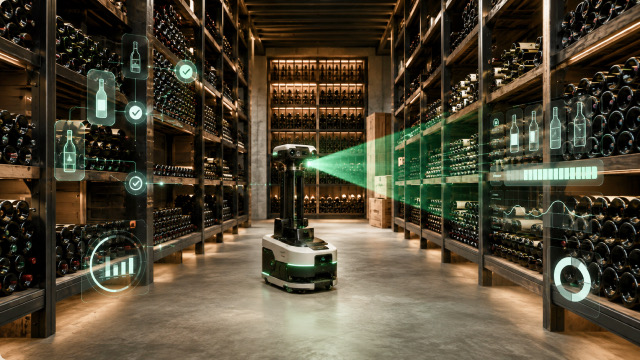
The best results we have seen come from systems that recommend rather than decide. The model proposes an order; the manager reviews it, adjusts for a local event or a supplier issue the data cannot know, and approves it in minutes rather than building it from scratch in an hour. Over time, as the recommendations prove reliable, the review becomes lighter and the manager’s time shifts to exceptions.
This is not a compromise. Store managers hold context that no model has: a road closure, a new competitor, a regular customer’s standing order. A system designed to use that context alongside the data outperforms one designed to replace it, and it earns the trust of the people who have to live with the results.
- Which items are out of stock most often, and what does each stockout cost in lost sales?
- How many weeks of supply are sitting in the slowest quarter of the assortment?
- How much time does the team spend building orders each week?
- Which of those numbers would a good forecast actually change?
Measure what the tool is supposed to move
An AI implementation should be judged on a few operating measures agreed before it starts: in-stock rate on the top-selling items, weeks of supply on slow movers, inventory turns by category, the gross margin return on the inventory investment, and the hours spent on ordering. If those do not improve within two or three ordering cycles, the problem is usually the data or the process, not the model, and it is better to find that out early.
The same measures make the business case for extending the tool to more categories or more locations. Standardized reporting across stores also does something subtler: it lets managers compare their decisions with those of their peers and learn from each other.
Where it fits in a portfolio
For an individual store, the barrier to AI has traditionally been cost and expertise. Owning several operating businesses changes the arithmetic. Shared data infrastructure, one set of standards for product records and receiving, and one team that understands the tools can be applied across every location. That is how technology, data, automation, and AI are integrated across the Gloria Capital portfolio: not as a series of separate experiments, but as a common operating capability that each business draws on.
The lesson for any retailer, inside or outside a portfolio, is the same. Fix the data, choose one problem, keep people in the loop, and measure the outcome. The AI is the easy part.
Key takeaways
- Clean product records, timely receiving, and disciplined counts come before any AI tool.
- Choose the one inventory problem with the largest cash impact and solve that first.
- Use systems that recommend and let managers approve, adjust, and handle exceptions.
- Agree the operating measures up front and judge the tool against them.
- Shared standards and infrastructure make AI affordable across multiple locations.

Quynh Pham
Co-Founder & Chief Executive Officer, Gloria CapitalQuynh leads portfolio operations, finance, talent, and technology across Gloria Capital's operating businesses.